
Loans & Sales · Philippine lawIndependent Philippine contract-lawyer review pending

Loans & Sales · Lenders · Borrowers

Guaranty Agreement

Also known as surety agreement, or co maker agreement.

Read the sample Guaranty Agreement

Have a guarantor promise to pay someone else's debt if the borrower doesn't, with a clear limit on how much and for how long.

Heightened care. The legal consequences are significant. Read the notes below closely and consider having a Philippine lawyer look at it before you sign.

Download the free sample (Word) Fictional details, no sign-in needed.

  • Free Word sample
  • Word and PDF download
  • 6 guided steps
  • Independent Philippine contract-lawyer review pending
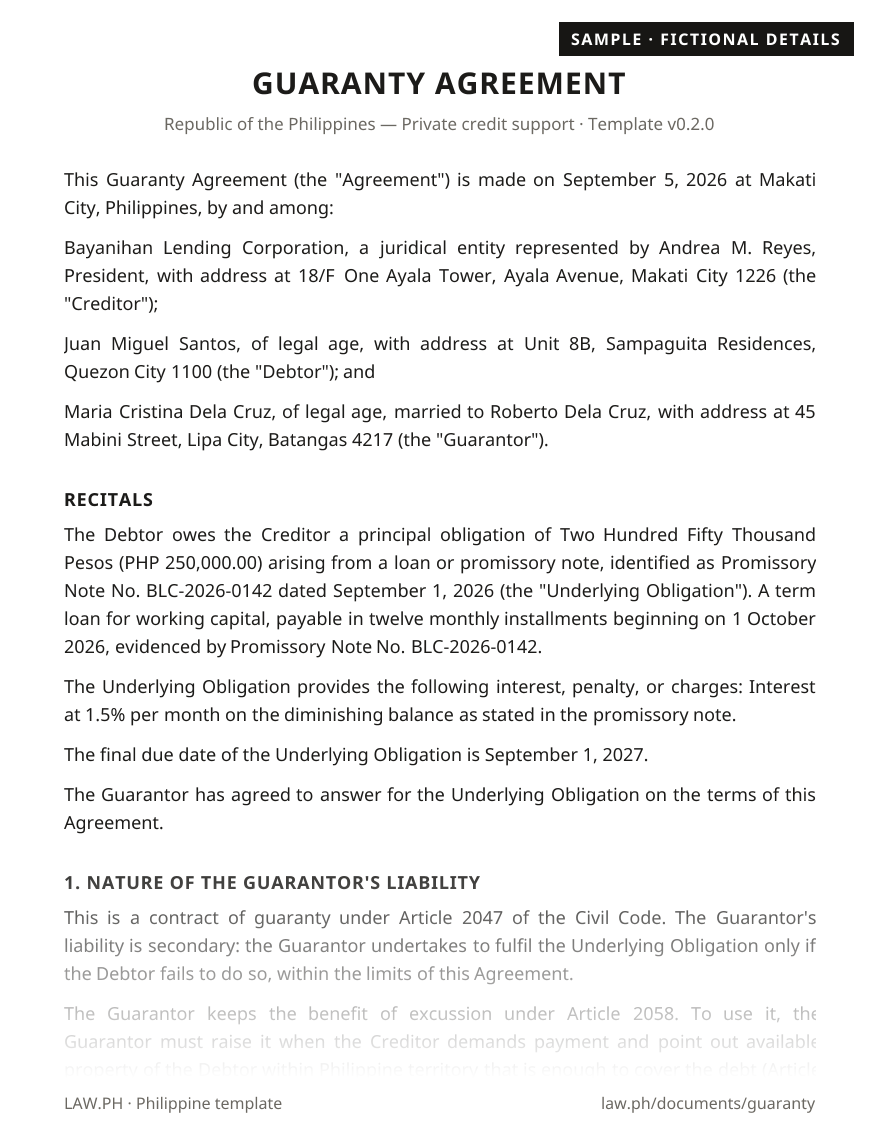
Guaranty agreement sample, Philippines: first page of the Guaranty Agreement with fictional details

Sample with fictional details. Read more of it →

How it works

  1. Answer the guided questions

    6 short steps, in plain language. Watch the document take shape as you go. No card, and no account needed to try it.

  2. Review it and save your draft

    Read the finished wording, the warnings that apply to you, and your signing checklist. Sign in to save your draft and come back to it.

  3. Pay once and download

    Pay ₱249 through secure PayMongo checkout, then download the Word and PDF files. Revise it for 30 days at no extra charge.

What is a Guaranty Agreement?

A Guaranty Agreement is a written agreement that records what the people involved have promised to do for one another.

What this template does. Document a guarantor's secondary obligation for an identified debt with scope and notice terms.

Also searched as

  • surety agreement
  • co maker agreement

Commonly used by

  • Lenders
  • Borrowers
  • Guarantors

Legal considerations

Heightened care. The distinction between guaranty and suretyship must be explicit; scope cannot exceed valid underlying obligations.

How it is signed

Depends on the route you choose. How it must be signed depends on the choices you make in the questions. Your signing checklist states exactly which formalities apply to your version.

What it draws on

  • Civil Code
  • Underlying loan
  • Consumer and lending rules where applicable

The exact provisions, with links to the official text, are listed under the Philippine law behind it.

How to complete your Guaranty Agreement

The guided interview takes you through 6 steps. The document updates as you answer, and some questions appear only when your earlier answers make them relevant.

  1. Step 1

    Choose the kind of guaranty

    Philippine law treats a guaranty (secondary liability) and a suretyship (solidary liability) very differently. Choose deliberately.

    Up to 3 questions
  2. Step 2

    Identify the parties

    Use full legal names and addresses that match IDs or registrations. The Guarantor must be someone other than the Debtor or the Creditor.

    Up to 11 questions
  3. Step 3

    Describe the debt being guaranteed

    A guaranty cannot exist without a valid principal obligation, and it cannot extend beyond it.

    Up to 10 questions
  4. Step 4

    Set the limits of the guaranty

    A guarantor cannot be bound for more than the debtor owes. State the cap, the period, and what happens if the debt is extended.

    Up to 8 questions
  5. Step 5

    Protect the Guarantor's right to be repaid

    A guarantor who pays may recover from the Debtor. Record what the Debtor knows and promises.

    Up to 4 questions
  6. Step 6

    Set venue, dispute route, and execution

    A notarized guaranty is a public instrument and is easier to prove and enforce, although a private written guaranty can be valid.

    Up to 10 questions

Sample Guaranty Agreement

This is how the opening of a finished document reads. Every name, address, and amount is invented. Your own document is built from your answers, so its wording changes with them.

11 clauses, about 1,030 words in the complete sample.

GUARANTY AGREEMENT

Republic of the Philippines — Private credit support · Template v0.2.0

This Guaranty Agreement (the "Agreement") is made on September 5, 2026 at Makati City, Philippines, by and among:

Bayanihan Lending Corporation, a juridical entity represented by Andrea M. Reyes, President, with address at 18/F One Ayala Tower, Ayala Avenue, Makati City 1226 (the "Creditor");

Juan Miguel Santos, of legal age, with address at Unit 8B, Sampaguita Residences, Quezon City 1100 (the "Debtor"); and

Maria Cristina Dela Cruz, of legal age, married to Roberto Dela Cruz, with address at 45 Mabini Street, Lipa City, Batangas 4217 (the "Guarantor").

Recitals

The Debtor owes the Creditor a principal obligation of Two Hundred Fifty Thousand Pesos (PHP 250,000.00) arising from a loan or promissory note, identified as Promissory Note No. BLC-2026-0142 dated September 1, 2026 (the "Underlying Obligation"). A term loan for working capital, payable in twelve monthly installments beginning on 1 October 2026, evidenced by Promissory Note No. BLC-2026-0142.

The Underlying Obligation provides the following interest, penalty, or charges: Interest at 1.5% per month on the diminishing balance as stated in the promissory note.

The final due date of the Underlying Obligation is September 1, 2027.

The Guarantor has agreed to answer for the Underlying Obligation on the terms of this Agreement.

1. Nature of the Guarantor's liability

This is a contract of guaranty under Article 2047 of the Civil Code. The Guarantor's liability is secondary: the Guarantor undertakes to fulfil the Underlying Obligation only if the Debtor fails to do so, within the limits of this Agreement.

The Guarantor keeps the benefit of excussion under Article 2058. To use it, the Guarantor must raise it when the Creditor demands payment and point out available property of the Debtor within Philippine territory that is enough to cover the debt (Article 2060).

2. Scope and Maximum Liability

This Agreement covers the unpaid principal together with the interest, penalties, and charges that the Underlying Obligation validly provides, and judicial costs incurred only after the Guarantor has been judicially required to pay (Article 2055).

In no event shall the Guarantor be required to pay more than Three Hundred Thousand Pesos (PHP 300,000.00) in total (the "Maximum Liability"). The Guarantor cannot be bound for more than the Debtor owes or on harsher conditions than the Debtor's (Article 2054).

Only demands made on or before March 1, 2028 are covered by this Agreement.

3. Validity of the Underlying Obligation

The Creditor states that the Underlying Obligation is lawful and valid. A guaranty cannot exist without a valid principal obligation (Article 2052), and the Guarantor may raise against the Creditor every defense that belongs to the Debtor and is inherent in the debt, but not defenses that are purely personal to the Debtor (Article 2081).

4. Default, notice, demand, and payment

The Creditor shall notify the Guarantor in writing within 15 days after the Debtor defaults, stating the amount unpaid and enclosing a statement of account. A late notice does not by itself release the Guarantor, but the Guarantor's liability is reduced by any loss the delay causes the Guarantor.

After a written demand that complies with this Agreement, the Guarantor shall pay the amount demanded, up to the Maximum Liability, within 15 days.

A payment by the Guarantor that is late bears interest at 6% per year on the overdue amount from the day after the payment deadline until paid. This is not an authority for an unconscionable rate, and a court may reduce an iniquitous interest or penalty.

5. Extensions and changes to the Underlying Obligation

The Creditor shall not extend the time for payment, renew, increase, or otherwise change the Underlying Obligation without the Guarantor's written consent. An extension granted to the Debtor without the Guarantor's consent extinguishes the guaranty (Article 2079). The Creditor's mere failure to demand payment after the debt falls due is not by itself an extension.

6. Recourse against the Debtor

A Guarantor who pays is subrogated to all the rights the Creditor had against the Debtor (Article 2067) and is entitled to be indemnified by the Debtor for the total amount paid, legal interest from the time payment was made known to the Debtor, expenses incurred after notifying the Debtor that payment had been demanded, and damages if due (Article 2066). On payment, the Creditor shall deliver to the Guarantor the documents and securities relating to the amount paid.

The Debtor knows of and consents to this Agreement.

By signing the conformity below, the Debtor promises to reimburse and indemnify the Guarantor for every amount the Guarantor pays under this Agreement, with the interest, expenses, and damages described above.

The rest of the document covers

  • 7. Consideration
  • 8. Marital property
  • 9. General terms
  • ACKNOWLEDGMENT — FOR THE NOTARIAL OFFICER TO COMPLETE
Free Word sampleThe complete sample above, with its signing checklist and source record. Fictional details, no sign-in.
Download .docx

Make it with your details

A finished document, built from your answers.

  • Editable Word and print-ready PDF

    Download the same finished document in both formats, generated from your exact answers.

  • Your purchased version stays yours

    The wording you paid for is locked and can be downloaded again at any time from your account.

  • 30 days of included revisions

    Change facts, dates, or parties in a separate revision draft and download the update at no extra charge.

  • Signing and execution checklist

    Plain steps for signatures, witnesses, notarization, registration, or tax filing where the document needs them.

  • Legal source record

    The Philippine statutes, rules, and provisions behind the template, with the date each was last checked.

Read the guide first.

Before you start.

How much is the Guaranty Agreement?
₱249, paid once. The interview and live preview are free, and the price covers the Word and PDF files, 30 days of revisions, and your account copy. There is no subscription. See all pricing →
How long does it take?
The guided interview has 6 steps and up to 46 questions. Some questions only appear when they apply to your situation, so you may answer fewer. You can read the document as it builds, and sign in to save a draft and finish later.
Do I need a notary?
Depends on the route you choose. How it must be signed depends on the choices you make in the questions. Your signing checklist states exactly which formalities apply to your version. Your signing checklist lists the exact steps for your version.
Is it reviewed by a lawyer?
This template’s current status is: Independent Philippine contract-lawyer review pending. LAW.PH is legal self-help software, not a law firm, and will not describe a document as lawyer-reviewed until an independent Philippine lawyer has approved this exact version.
Is there a free template?
Yes. The sample on this page is free to read and to download as an editable Word file, with no sign-in. It uses fictional names, dates, and amounts, so replace every one. The paid version is built from your own answers, checks them as you go, and includes the signing checklist for your exact situation. Download the free sample (.docx)
Can I change it after I buy it?
Yes. For 30 days you can create a separate revision draft, update your answers, and download the revised files at no extra charge. The version you originally bought is preserved unchanged.
Which law does it follow?
It is drafted under Philippine law and relies on 9 official sources, each listed above with the provisions used and the date it was last checked.
Loans & Sales

Create your Guaranty Agreement.

Free to start. You pay ₱249 only when you are ready to download.

Start this document
Guaranty Agreement₱249 · one-time · Word + PDF
Start this document